
Poland Venezuela Crypto Oil Deal
Disclaimer: This article is for informational and educational purposes only and reflects the author's interpretation and analysis. It is not legal, financial, investment, tax, or regulatory advice.
In November 2023, Poland's state controlled energy group Orlen, through its Swiss trading subsidiary, Orlen Trading Switzerland (OTS), signed a contract to purchase roughly six million barrels of Venezuelan Merey 16 crude for about $345 million.
The deal reportedly originated at a meeting between OTS head and founder of Dubai based Hannon International. The contract called for an advance of two thirds of the total value, and within five days, Hannon had received $230 million, reportedly without collateral or bank guarantees, a notable departure from Orlen's typical use of letters of credit for crude purchases. (Forklog)
In This Article, You'll Learn
- ✓ What actually happened in the Orlen deal with Venezuela, step by step
- ✓ How banks traditionally protect both sides of a cross border commodity trade
- ✓ Why smart contracts could, in theory, tie payment directly to delivery
- ✓ What the "oracle problem" is, and why it's the real limit on that idea
- ✓ Why the lesson here is about verification infrastructure, not crypto itself
What Happened?
| Step | What happened |
|---|---|
| 1 | Orlen's Swiss trading arm, OTS, wanted Venezuelan oil. |
| 2 | OTS contracted Hannon International, a Dubai based trading company. |
| 3 | Orlen agreed to pay $345 million for roughly 6 million barrels. |
| 4 | Orlen sent Hannon $230 million upfront. |
| 5 | Hannon was expected to use those funds to secure the oil. |
| 6 | The Venezuelan transaction involved payment in USDT, a dollar pegged stablecoin. |
| 7 | Hannon converted the funds into USDT through intermediaries. |
| 8 | USDT was transferred to Venezuelan brokers. |
| 9 | Some of those brokers reportedly failed to deliver the promised oil. |
| 10 | The oil never arrived in the contracted quantity. |
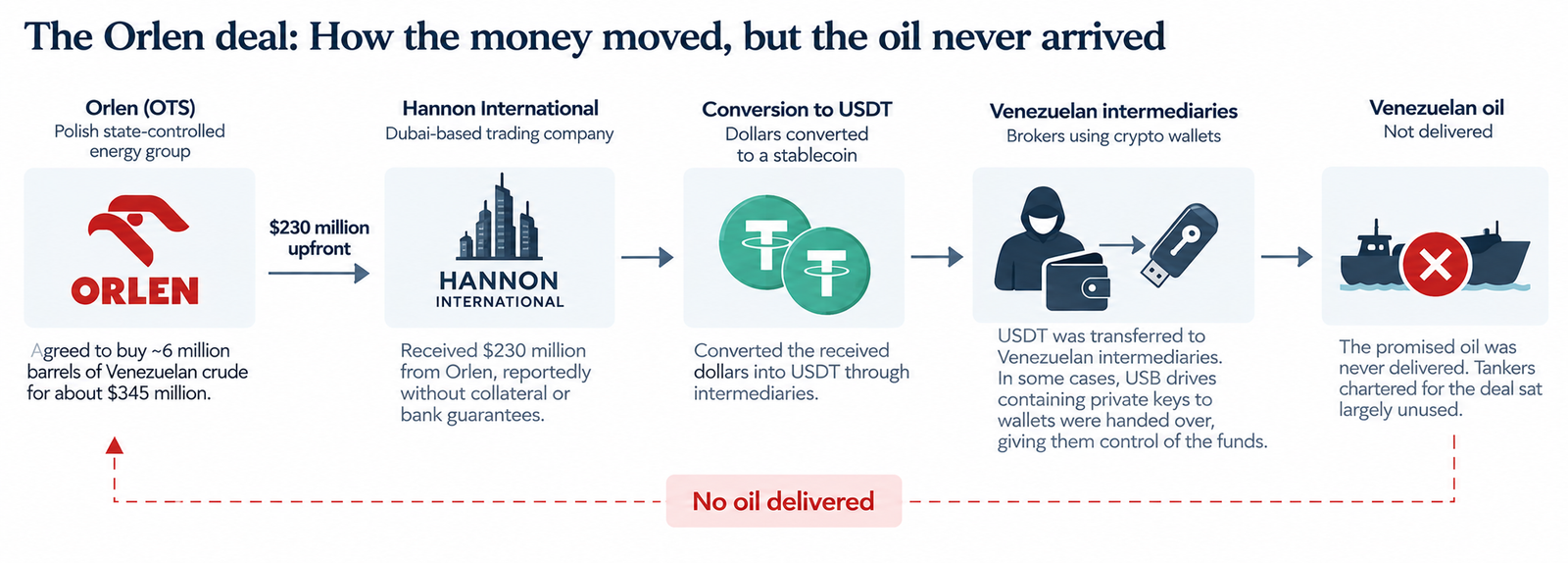
The trade ultimately delivered nowhere near what was promised. Tankers chartered to carry the oil sat largely unused. Polish prosecutors later opened an investigation, while reports have put the scale of the losses at different levels depending on which OTS transactions are included. Reuters separately traced $330 million paid by OTS to two Dubai based intermediaries for Venezuelan oil that Venezuela's state oil company never received, while total losses across OTS's prepayments, not limited to this particular deal, have been estimated by Orlen and Polish authorities at around $400 million. These figures refer to different scopes and should not be treated as a single loss figure. (Reuters)
The mechanism is what makes the story particularly interesting. Cut off from dollar denominated banking channels by US sanctions, Venezuela's state oil company had shifted much of its trading toward a model involving prepayment in USDT, requiring counterparties to use crypto wallets. Hannon converted the dollars it received from Orlen into USDT and passed funds through a chain of intermediaries. Some were reportedly reached in Caracas using USB drives containing wallet keys. Large sums therefore moved through wallets with no clear connection to an accountable institution, and much of the money was never accounted for. (Forklog)
By 2024, under new leadership at Orlen following political change in Poland, the company cancelled its remaining Venezuelan contracts. A Warsaw court later ordered a former OTS executive detained as part of the investigation. Orlen has since recovered at least part of the money through a settlement: $100 million from intermediary Horizon Global, to be repaid in tranches, while continuing to pursue the remaining funds. (MarketScreener)
The Question Worth Asking
It's tempting to read this as a story about crypto being inherently risky. That's too easy, and it misses what actually went wrong.
Blockchains are, in many respects, more transparent than conventional banking: transactions are typically recorded on a public, permanent ledger. What failed here wasn't the technology's ability to move money accurately. It was everything surrounding that transfer: no verification of who controlled the receiving wallets, no collateral, no independent confirmation that the oil existed or would ship, and a payment structure that placed the risk largely on the buyer upfront.
That raises the real question this case is useful for exploring:
How Banks Normally Solve This Problem
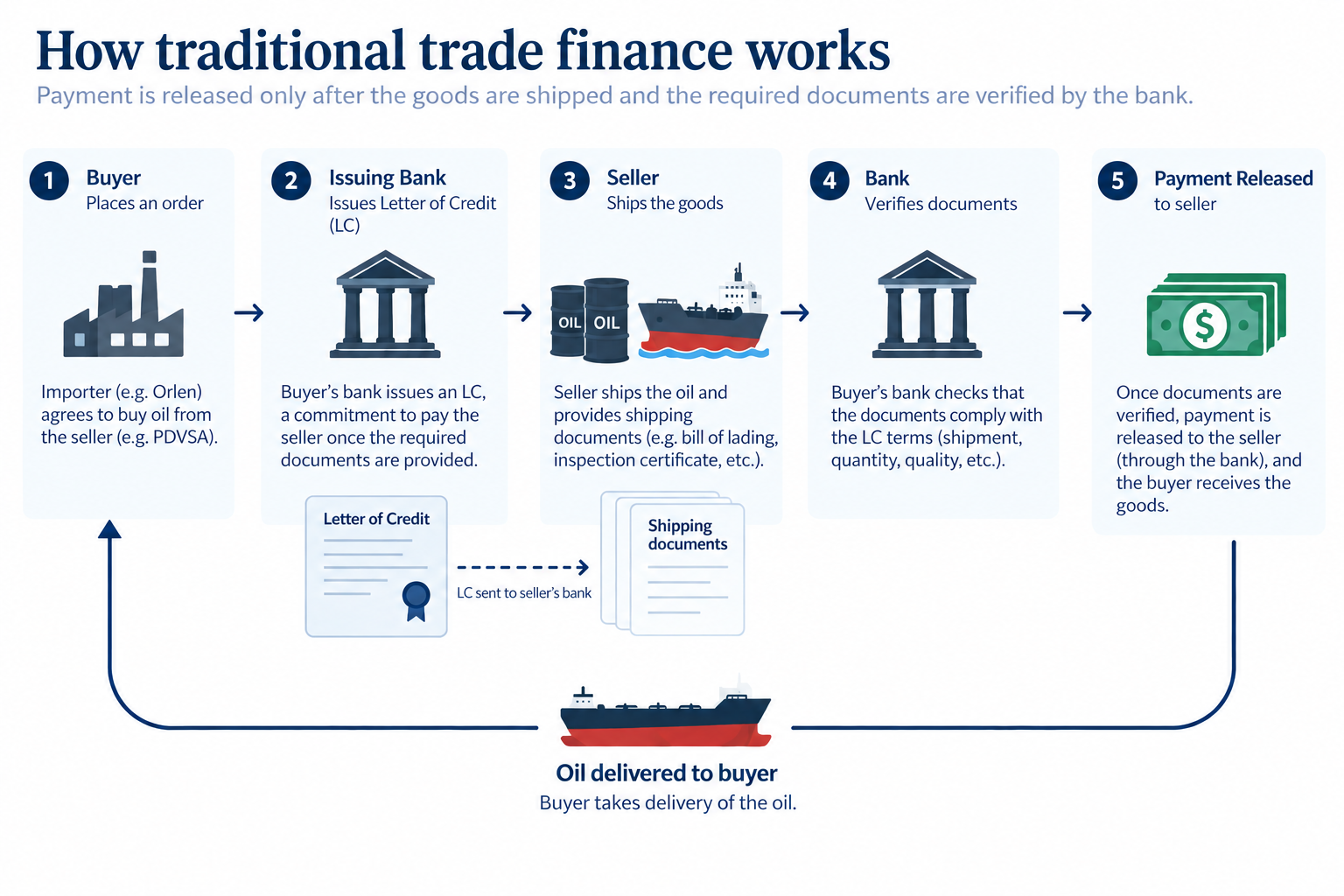
International commodity trade has always faced the same structural tension. A buyer doesn't want to send tens of millions of dollars before receiving the cargo; a seller doesn't want to load a tanker before being certain of payment. Neither side wants to extend trust unilaterally to a counterparty they may never have dealt with before.
Traditional trade finance exists specifically to manage that standoff:
- Letters of credit:
- Collateral and guarantees: Banks or insurers provide additional protection if one party defaults, creating a recoverable claim against an identifiable counterparty.
- Independant inspection: A third party can verify the quantity and quality of the goods at loading. This gives the buyer evidence that the physical asset actually exists and meets the agreed specifications.
- Bills of lading and shipping documents: These documents provide evidence that the goods were loaded and are being transported to the buyer. They can also form part of the conditions the bank requires before releasing payment.
- Collateral and guarantees: Banks or insurers provide additional protection if one party defaults, creating a recoverable claim against an identifiable counterparty.
None of this makes fraud or non delivery impossible. But the underlying principle is the same one at the heart of programmable settlement: payment is linked to verified conditions and executed through parties that can be identified and held accountable.
Why "Just Use Blockchain" Doesn't Automatically Fix This
Here's where the more interesting idea comes in.
If blockchain makes money programmable, why not build a version of a letter of credit that runs itself?
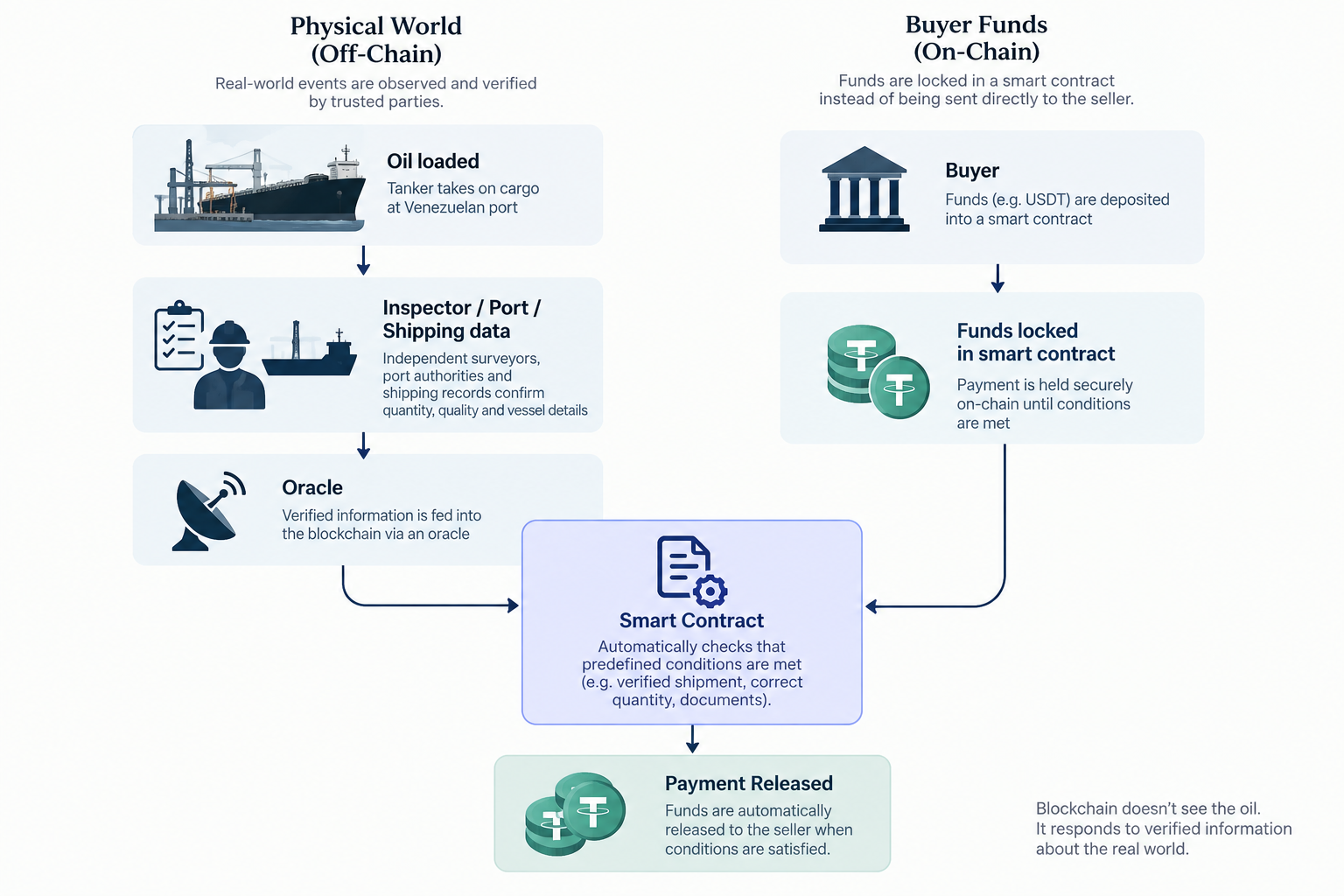
In principle, a buyer could lock funds in a smart contract rather than wiring them directly to a seller. The contract could release payment only when predefined conditions are verified: cargo loaded, quantity and quality confirmed by an inspector, the correct vessel identified and documentation matched.
Payment could also be split into milestones tied to partial deliveries rather than one all or nothing transfer, limiting the buyer's exposure to what has actually been verified.
That would invert the structure of the Orlen deal:
Large payment → delivery
becomes
Delivery → verification → payment
The financial and physical transactions move in parallel, with payment gated by verification.
But this is exactly where blockchain reaches its real limit: the oracle problem.
A blockchain can only directly know what happens on the blockchain. It has no native way to confirm that a tanker actually took on a million barrels of crude in a Venezuelan port.
Someone, an inspector, port authority or shipping tracker, has to observe that event in the physical world and feed a trustworthy report into the smart contract through an oracle.
If that reporting mechanism can be manipulated, bribed or simply doesn't exist, the smart contract will execute flawlessly on false information.
This is also why blockchain doesn't eliminate the roles banks and inspectors already play. It can change what those roles do, automating reconciliation and settlement, for example, but it still depends on identity verification, asset custody and legal recourse somewhere in the system.
USDT could move exactly as instructed in the Orlen case. Nothing about the blockchain itself had to malfunction. The blockchain simply had no way of knowing whether the wallets receiving that USDT belonged to parties that actually had oil to sell.
The Actual Lesson
The Orlen case isn't so much a cautionary tale about cryptocurrency as it is about skipping verification infrastructure, regardless of which rails the money moves on.
A bank wire without a letter of credit, collateral or independent inspection could be similarly exposed to fraud. The difference is that the banking system would provide a different set of controls and records around the transaction.
The more useful takeaway is architectural: digital settlement is only as trustworthy as its connection to the real world facts it is supposed to depend on.
Programmable payments, whether built with smart contracts or, more traditionally, conditional letters of credit, are valuable to the extent that the verification feeding them is reliable, independent and difficult to manipulate.
Put money on chain and nothing fundamentally changes about that requirement.
Put the conditions for releasing that money on chain, backed by verification robust enough to trust, and you have something genuinely different.
Key Takeaways
- Orlen paid a $230 million advance, without collateral, to a newly formed intermediary, a marked departure from its usual letter of credit process.
- Reported loss figures differ by scope: $230 million as the advance, $330 million as Reuters traced payments, and roughly $400 million as total OTS prepayment losses are not the same number.
- Blockchains are typically more transparent than conventional banking, so the failure here was around the transfer, not the technology's accuracy.
- Traditional trade finance, including letters of credit, documentary collections, independent inspection and collateral, exists to tie payment to verified delivery, the exact safeguard this deal skipped.
- Smart contracts could programmatically enforce that same link, but they run into the "oracle problem": a blockchain can't independently verify what happened in the physical world, only what's reported to it.