
Bitcoin, Ether Surge as Trump Urges Congress to Pass the CLARITY Act: What the Crypto Bill Could Change
Disclaimer: This article is for informational and educational purposes only and reflects the author's interpretation and analysis. It is not legal, financial, investment, tax, or regulatory advice.
Bitcoin and ether jumped on August 20, 2026, after President Donald Trump urged Congress to pass the Digital Asset Market CLARITY Act, renewing attention on legislation that could fundamentally reshape how cryptocurrencies are regulated in the United States.
Bitcoin briefly moved above $70,000, while ether rose even more sharply. Other crypto assets also rallied, including the token associated with Hyperliquid, after Trump indicated that regulators were working toward bringing the platform into a U.S. regulatory framework.
While several factors contributed to the broader crypto rally, Trump's renewed support for the CLARITY Act stood out as an important signal to the crypto industry that the U.S. administration was continuing to move toward a clearer regulatory framework for digital assets.
The significance of the legislation goes beyond token classification. The proposed framework also addresses crypto exchanges and other intermediaries, decentralized finance, stablecoins, banking activities involving digital assets, self-custody, blockchain software developers, NFTs, and digital-asset consumer protection.
That brings us to a question that has hung over the U.S. crypto industry for years: what exactly is a digital asset under U.S. law, and when should it be regulated as a security, and when as a commodity or another type of digital asset?
That question sits at the center of the CLARITY Act.
What Is the CLARITY Act Trying to Acheive?

The Digital Asset Market CLARITY Act of 2025, H.R. 3633, is a comprehensive attempt to establish a federal regulatory framework for digital assets in the United States.
The House passed the legislation in July 2025. The Senate subsequently developed its own version, and the current Senate-reported version was reported on June 1, 2026. As of September 2026, the legislation has not become law.
At a high level, the bill tries to answer several questions:
- Which digital assets should be regulated as securities?
- Which should be treated as digital commodities?
- Which regulator, the SEC or CFTC, should have primary oversight?
- How should the original issuance of a token be treated?
- What happens when that token later trades in the secondary market?
- How should decentralized networks and DeFi protocols be treated?
- What rules should apply to exchanges and other digital-asset intermediaries?
- How should banks interact with digital assets?
- What rights should individuals have to self-custody their assets?
- How should stablecoins fit into the financial system?
There are also provisions dealing with illicit finance, consumer protection, software developers, NFTs, banking, cybersecurity, and other areas.
But the central issue is classification. The CLARITY Act is fundamentally trying to create a clearer framework for determining when digital assets fall within the securities framework and when they may instead receive treatment as digital commodities or other non-security digital assets.
The Fundamental Problem: Is a Crypto Token a Security or a Commodity?
The regulatory problem begins with a basic observation: not every digital asset works in the same way.
Imagine a company creates a new cryptocurrency to build a blockchain network. It sells the tokens to investors to raise money for developing the project.
At this stage, the buyers may be investing partly because they expect the company's team to build the network, develop the technology, attract users, and ultimately increase the value of the token.
Now imagine that several years later, the network is fully operational and widely used. Thousands of independent participants run the network, developers contribute to it, and no single company has the same level of control over its operation or value.
Is the token still the same kind of financial asset from a regulatory perspective? This is where the distinction between securities and commodities becomes important.
What Is a Security?
In simple terms, a security is a financial asset that represents an investment or financial interest and is subject to U.S. securities laws. Stocks and bonds are familiar examples.
Securities are subject to a relatively extensive regulatory regime, with a strong emphasis on investor protection and disclosure. When investors are putting their money into a project and may depend on the efforts of an issuer or promoter, the law can require information that helps them understand what they are investing in.
Depending on the circumstances, this can include:
- Information about the company or project
- Financial information
- Management and ownership
- Material risks
- Information about the asset and how it works
- Related-party transactions
- Ongoing updates and reporting
The SEC, or Securities and Exchange Commission, is the primary federal regulator of securities markets.
What Is a Commodity?
A commodity, on the other hand, is generally an asset that is traded based on its market value, such as gold, oil, or wheat.
The regulatory framework for commodities is different and generally does not impose the same issuer-level disclosure regime on the underlying asset. Commodity regulation focuses heavily on the integrity of markets and trading activities, rather than issuer-related activities.
The CFTC, or Commodity Futures Trading Commission, is the primary federal regulator of U.S. commodity derivatives markets.
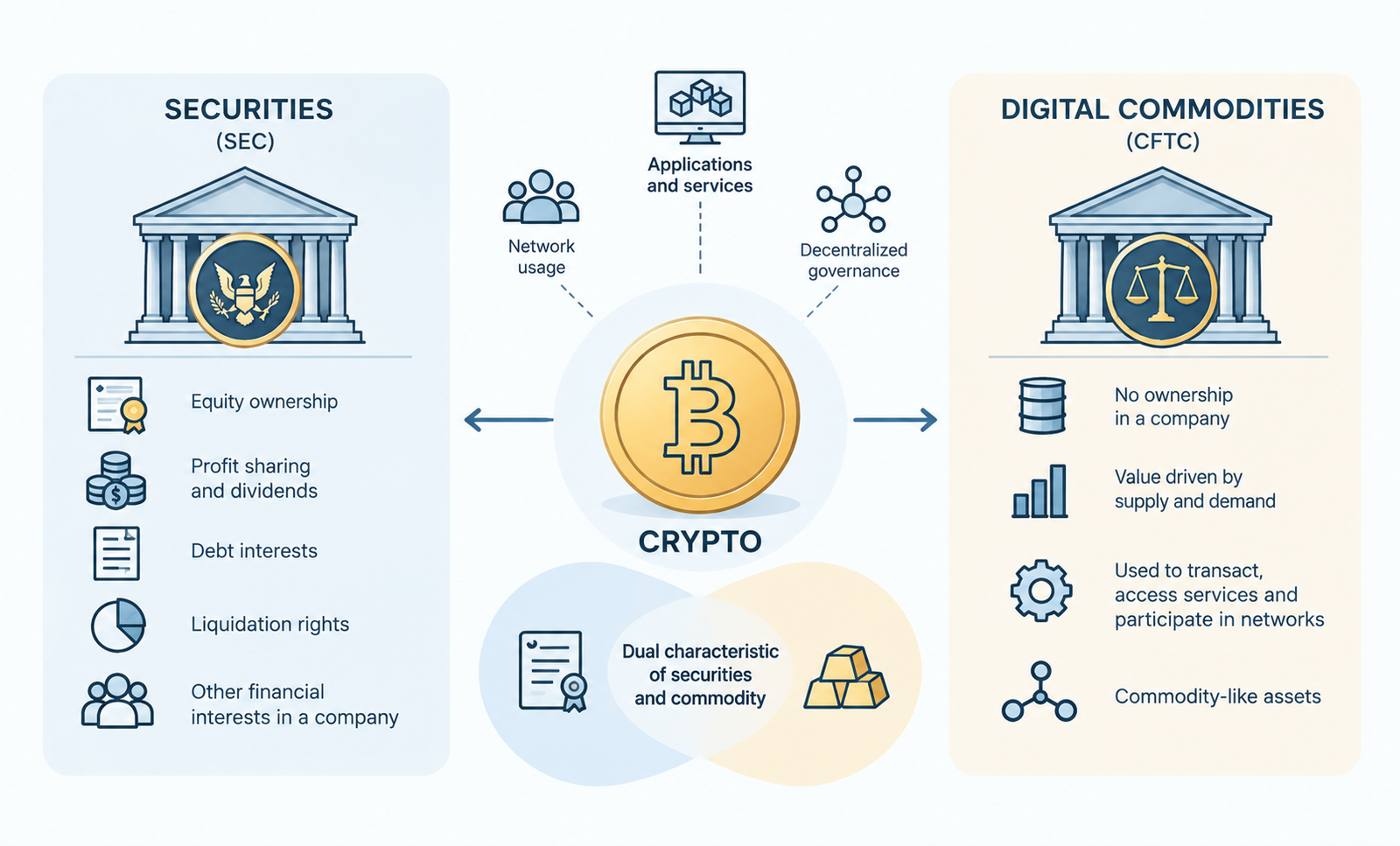
Crypto Can Have Characteristics of Both Securities and Commodities
The CLARITY Act attempts to create a statutory framework that recognizes this difference, and gives a framework for determining when a digital asset should be treated as a security and when it may instead receive treatment as a digital commodity.
And this is where two concepts become particularly important: ancillary assets and network tokens.
What Is a Network Token?
The CLARITY Act introduces the concept of a network token as part of its framework for classifying digital assets.
In simple terms, a network token is a type of digital asset that is closely connected to the functioning and use of a blockchain or other distributed ledger network.
For example, imagine a blockchain network that allows users to send transactions, use applications, and participate in the operation of the network. Its network token could be used within that system, with its value connected to the demand for using the network.
The bill says that a token is considered closely linked to a distributed ledger system when it is directly related to:
- The functioning or operation of the network
- The activities or services for which the network was created or is used
What Does Not Qualify as a Network Token?
The CLARITY Act also sets boundaries around what can qualify as a network token. The bill excludes certain tokens that carry specific financial rights, which it refers to as "disqualifying financial rights."
These include:
- Debt or equity interests in a person or company
- Options on debt or equity interests
- Liquidation rights
- An entitlement or reasonable expectation of interest, dividends, payments, or other transfers of value from a person
- Certain other financial interests in a person, including certain partnership or intellectual-property interests
- Certain interests in investment companies
- Certain interests in entities that hold or will hold assets other than securities
By contrast, imagine a token that is used to pay transaction fees, access services, interact with applications, participate in network operations, or contribute to the functioning of the blockchain. Its value may increase or decrease, and it may be freely traded, but those characteristics alone do not turn it into a traditional financial interest in the company behind the network.
The key distinction is what the token represents: a token tied to the functioning and use of the network may qualify as a network token, while a token that represents ownership, profit rights, payment rights, liquidation rights, or other specified financial interests in a company or person is excluded.
The bill also clarifies that economic or voting rights relating to the distributed ledger or its decentralized governance system do not, by themselves, disqualify a token from being a network token. The key question is whether the token carries one of the specific financial rights excluded by the bill.
What Is an Ancillary Asset?
Let's go back to the example we started with.
Imagine a company creates a new cryptocurrency to build a blockchain network. It sells the tokens to investors to raise money for developing the project.
At this stage, the company is actively involved in building the network. It is developing the technology, attracting users, promoting the project, and making decisions about how the network will evolve.
The buyers of the token may therefore be relying, at least in part, on what this company and its team do in the future.
This is where the CLARITY Act's concept of an ancillary asset comes in.
Under the proposed legislation, an ancillary asset is a network token whose value depends on the entrepreneurial or managerial efforts of the person or group that created or issued it.
In our example, the token could fall within this concept because the company's efforts to develop and grow the blockchain are connected to the value of the token.
Importantly, the token does not have to represent ownership in the company. It does not necessarily give the holder shares, voting rights in the company, or a claim on the company's profits.
The important question is the connection between the value of the token and the efforts of the people behind the project.
Why Call It an "Ancillary" Asset?
The term ancillary asset reflects the fact that the token is connected to the project and the efforts being made to develop it, even though the token itself does not represent a traditional ownership interest in the company.
In our example, the token is connected to the blockchain project and the efforts behind it, but owning the token does not mean owning part of the company.
This distinction is important. An ancillary asset does not mean that the holder owns part of the company behind the project. A token that represents shares in a company, for example, would give the holder an equity interest and would be treated differently under the proposed framework.
Why Does the CLARITY Act Need the Concept of an Ancillary Asset?
A traditional security represents a financial relationship with an issuer. It can give investors rights such as equity, profit-sharing, dividends, or other claims on the issuer. Securities are generally subject to the regulatory framework of the SEC, including rules around disclosure, trading, and investor protection.
A commodity, by contrast, does not generally represent ownership or a financial claim on the company that created it. Its value is primarily determined by supply, demand, and its use or utility in the market. Under the proposed framework, digital commodities would fall primarily within the regulatory jurisdiction of the CFTC.
This creates an interesting situation for crypto tokens.
1. Tokens With Financial Rights
Consider a token that gives holders an interest in a company, a share of its profits, dividends, liquidation proceeds, or another specified financial interest.
The token has a clear financial relationship with the company. The CLARITY Act therefore excludes these interests from the definition of a network token. In character, this is much closer to a traditional security, where the investor's rights are connected to the issuer.
2. Network Tokens That Are Not Ancillary Assets
Now consider a network token that does not give holders those financial rights and whose value is no longer dependent on the entrepreneurial or managerial efforts of a particular company or group.
The token is primarily connected to the functioning and use of the network. People may need it to transact, use applications, participate in the network, or access its services. Its value is driven increasingly by network usage, supply, and demand, rather than by a continuing expectation that a particular company will make the token valuable.
This gives the token characteristics that are much closer to a commodity or commodity-like asset, rather than an investment in a company.
3. Ancillary Assets
But what happens when the token has no financial rights in the company, yet its value still depends significantly on the entrepreneurial or managerial efforts of the people behind the network?
The token does not look like a traditional security because holders do not have an equity interest, profit claim, or similar financial right in the company.
But it also does not yet behave entirely like an independent commodity, because the value of the token remains dependent on the continued efforts of its originator or a related person.
This is where the CLARITY Act introduces the concept of an ancillary asset. The bill defines an ancillary asset as a network token whose value is dependent upon the entrepreneurial or managerial efforts of its originator or a related person.
So, conceptually, we can think of the three categories like this:
| Type of Asset | Key Characteristic | Closest Regulatory Treatment |
|---|---|---|
| Token with financial rights | Represents a financial interest in a company/person | Security / SEC |
| Network token, not ancillary | Primarily tied to the functioning and use of a network, without dependence on a particular originator's efforts | Commodity-like / CFTC |
| Ancillary asset | Network token whose value still depends on the originator's entrepreneurial or managerial efforts | Subject to the specific framework established for ancillary assets |
How Does the CLARITY Act Treat an Ancillary Asset?
Let's go back to our example of the company that created a blockchain network and issued a token to help fund its development.
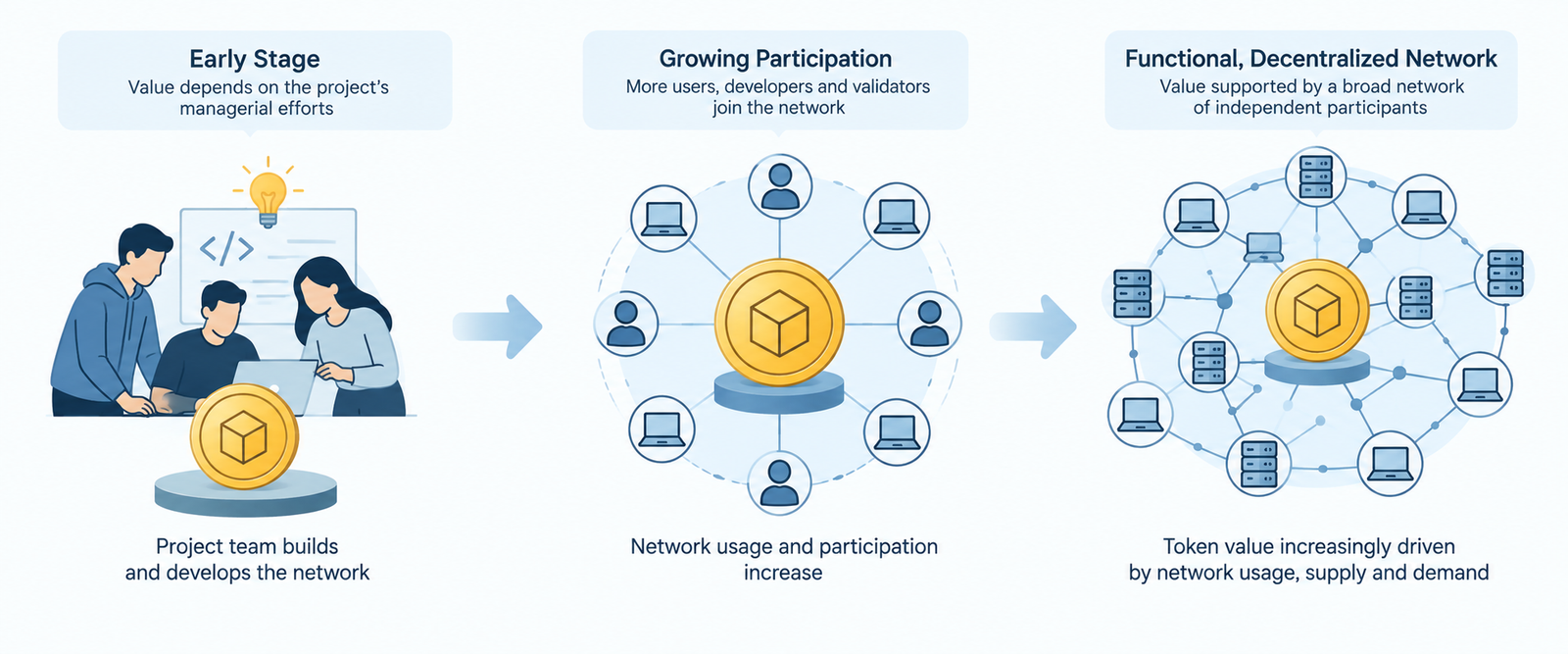
In the early stages, the network depends heavily on the company's founders and management team. They are building the technology, developing the network, attracting users, and making decisions about how the project evolves.
As a result, the token's value depends significantly on the entrepreneurial and managerial efforts of the company. This is what can give the token characteristics of a security, bringing it within the SEC's regulatory framework.
But as the network develops, this can change.
More users begin using the network. Independent developers build applications on it. Other participants help operate the network. Governance becomes more distributed. The company that originally created the network gradually becomes less important to the network's continued functioning.
The token's value therefore becomes less dependent on the company's managers and more dependent on the network itself, including its adoption, usage, and functioning.
At this point, the token begins to behave more like a commodity than a security. Its value is increasingly driven by the demand for and use of the network, rather than by the continued efforts of a particular company or management team.
When Can an Ancillary Asset Receive Commodity Treatment?
This raises a significant question: when does a token that was initially dependent on the efforts of a particular company become sufficiently independent from those efforts as the underlying network becomes more decentralized?
The legislation establishes a process through which an ancillary asset can receive non-security treatment if the relevant requirements are satisfied.
A key requirement is that the underlying distributed ledger system is not under the coordinated control of the originator or other related persons. In other words, the network must have developed to a point where its operation and governance are no longer effectively controlled by the company or group that originally created it.
The relevant party can submit a certification to the SEC, supported by evidence demonstrating that the applicable requirements have been met. The bill also allows for advance review of a certification before the network token is offered, sold, or distributed.
If the certification becomes effective and the applicable conditions continue to be satisfied, the asset can receive non-security treatment under the federal securities laws and move into the bill's digital commodity framework, where the CFTC has the relevant regulatory role.
What Makes a Network Decentralized?
As we saw above, decentralization is a key factor in determining whether an ancillary asset can move toward the digital commodity side of the regulatory framework.
The central question is: how much control does a person or group still have over the network?
One of the key concepts is coordinated control. Broadly, this refers to a person or group acting together that has the ability to exercise significant control over the distributed ledger system, including its functionality, operation, consensus mechanisms, or rules.
A network is less likely to be considered decentralized when a single person or coordinated group can still make these decisions unilaterally.
The legislation identifies several factors that can indicate this type of control, including situations where:
- The system is not openly accessible, or its source code is not generally available.
- A person or group can unilaterally restrict participation or censor transactions.
- A person or group controls more than 49% of the beneficial ownership of the token units or governance voting power.
- The system is not autonomous, and a person or group can unilaterally modify its functionality or operation.
- Important mechanisms through which value accrues to the network are not yet functional.
At the same time, decentralized governance does not automatically prevent a network from being considered decentralized. Certain administrative, technical, or governance activities may still be carried out without creating coordinated control, provided they do not give a person or group unilateral control over the network.
The underlying principle is therefore fairly straightforward: the more unilateral control an identifiable person or group retains over the network, the harder it is for the asset to qualify for the different regulatory treatment provided by the bill.
And this is where coordinated control becomes particularly important. The bill treats the absence of coordinated control as an independent requirement, meaning that simply reducing a company's day-to-day involvement is not necessarily enough. The question is whether meaningful control over the network has actually been distributed.
Transactions That Are Not Treated as Ancillary-Asset Transactions
The bill identifies certain types of transactions and distributions that receive different treatment from the general ancillary-asset framework.
1. Secondary Sales
When someone other than the issuer, its agent, or underwriter later sells a token that was originally offered or sold in connection with an investment contract.
2. Gratuitous Distributions
The bill defines a gratuitous distribution as:
In simple terms: a gratuitous distribution is essentially a rule-based distribution of network tokens for free (or basically free, i.e., for only a very small amount), handed out fairly and according to predetermined rules, rather than being individually negotiated or sold to specific buyers.
A gratuitous distribution is:
- Broad: It is available to a broad group of participants rather than just a select few.
- Equitable: The tokens are distributed fairly according to the applicable rules.
- Non-discretionary: The distribution follows predetermined rules rather than someone deciding individually who should receive the tokens.
The bill specifically includes the following mechanisms and methods of distribution:
a. Self-Staking
The distribution of tokens as a programmatic result of staking or validating activity when the person staking the tokens also operates the node or validator.
b. Self-Custodial Staking With a Third Party
The distribution of tokens as a programmatic result of staking or validating activity when the token holder and the validator are different, and the validator does not have custody or control of the staked tokens.
c. Liquid Staking
The issuance, transfer, or redemption of liquid staking tokens that represent a proportional interest in staked tokens and their associated rewards.
d. Custodial and Ancillary Staking Services
The distribution of tokens as a result of staking or validating activity where a staking service provider has custody of the staked tokens and provides the administrative or technical services needed to participate in staking.
e. Programmatic and Automated Distributions
Recipients receive network tokens as a direct, programmatic result of objective and verifiable network participation, consumption, or contribution, including consensus participation, data availability, bandwidth, governance, or use and interaction with the protocol or application. The number of tokens received is proportionate to the person's verifiable participation, use, or contribution.
f. Technology-Neutral Clause
The distribution of network tokens through a mechanism, protocol, or technology not specifically covered by the other categories, including one that may not even exist when the law is enacted, provided the distribution still meets the basic requirements of a gratuitous distribution.
What Else Does the CLARITY Act Cover?
Beyond the classification of digital assets, the CLARITY Act addresses several other areas of the crypto market:
Digital-Asset Intermediaries
The CLARITY Act also establishes a regulatory framework for the businesses that facilitate digital-asset trading. It provides for registration of digital commodity exchanges, brokers, and dealers, including expedited registration and provisional status for certain existing businesses.
The bill also addresses alternative trading systems, dual registration with the SEC and CFTC, recordkeeping, conflicts of interest, and anti-fraud requirements.
Decentralized Finance
DeFi creates a particularly difficult regulatory question because financial transactions can take place without a traditional intermediary such as a bank, broker, or exchange operating in the middle.
The bill therefore distinguishes between genuinely decentralized protocols, where transactions are executed through predetermined rules and no person or group has meaningful control, and protocols where an identifiable person or group retains the ability to control or materially change how the system operates.
For these non-decentralized protocols, the bill directs the SEC to establish rules for how existing securities and related regulatory requirements should apply to the people or groups exercising control, based on the financial functions they actually perform. At the same time, the bill seeks to protect the ability of software developers to create, publish, and use blockchain software, while allowing existing regulatory requirements to apply where identifiable people are actually performing regulated financial functions, such as brokerage, dealing, trading, execution, clearing, or custody.
Stablecoins
Stablecoins receive significant attention because they increasingly connect blockchain markets with traditional payments and financial infrastructure.
The legislation addresses payment stablecoins and, among other things, distinguishes activity-based rewards from simply paying customers interest or yield merely for holding stablecoins.
The stablecoin provisions have become an important point of debate between the crypto industry and traditional banking interests.
Banks and Digital Assets
The bill also seeks to provide greater certainty for banks and other regulated financial institutions engaging in legally permissible digital-asset activities.
It specifically addresses activities such as digital-asset custody, staking-related services, digital-asset lending, payments, loans collateralized by digital assets, operating blockchain nodes, and providing self-custodial wallet software.
The underlying principle is that the use of digital assets or blockchain technology should not, by itself, make an otherwise permissible banking activity impermissible or subject it to a separate prohibition simply because the activity involves blockchain technology.
Self-Custody
The CLARITY Act also protects an individual's ability to self-custody digital assets. It provides that a U.S. individual may maintain a hardware or software wallet to hold their own digital assets and may conduct lawful peer-to-peer transactions using that wallet.
This means that individuals can continue to hold their own private keys and transact directly, rather than being required to use a bank, exchange, or other custodian simply to hold or transfer digital assets.
The protection is subject to existing laws concerning areas such as money laundering, illicit finance, and U.S. sanctions.
Software Developers
The CLARITY Act also seeks to protect software developers and others who provide technical infrastructure for blockchain networks.
Under the bill, a person would not become subject to securities laws solely because they perform certain technical activities related to a distributed ledger system, such as compiling or relaying transactions, validating transactions, operating a node or oracle, providing computational work or network bandwidth, or providing similar incidental services.
This is intended to ensure that building or using blockchain software does not, by itself, turn a developer or infrastructure provider into a regulated financial intermediary.
What Could the Future of Digital-Asset Regulation Look Like?
The legislation also contains a number of studies and reports concerning issues that Congress wants to understand better before deciding how future regulation should evolve.
These include areas such as:
- Digital-asset mixers and tumblers, which can make it harder to trace the source or ownership of digital assets, including their legitimate privacy uses, potential use in illicit finance, and possible regulatory approaches.
- Foreign digital-asset intermediaries, particularly platforms operating outside the United States that serve U.S. users and may not be subject to comparable anti-money-laundering requirements.
- Foreign adversary involvement in digital-asset markets, including potential access to trading data and intellectual property.
- Decentralized finance (DeFi), including the potential financial-stability risks associated with decentralized trading and lending.
- Cybersecurity in digital-asset markets, including relevant standards, vulnerabilities, and potential risks.
- Tokenized securities and financial-market infrastructure, including whether additional SEC or CFTC rules or guidance may be needed.
- Blockchain-based payments, including whether blockchain technology can reduce transaction costs, improve payment efficiency, and enable automated payments.
- Non-fungible tokens (NFTs), including their economic role, potential risks, legitimate uses, and interaction with traditional financial markets.
- Financial literacy, including ways regulators can improve the information available to retail digital-asset users.
Why Did the Market Care About Trump's Comments?
This brings us back to the August 20 rally.
The immediate market reaction was not simply a bet that Congress would pass a particular bill. Investors were also responding to the possibility of a more predictable regulatory environment.
Greater regulatory certainty could make it easier for:
- Financial institutions to enter the market
- Exchanges to establish compliant U.S. operations
- Institutions to custody digital assets
- Companies to develop blockchain-based products
- Investors to understand their regulatory exposure
- Blockchain projects to determine what rules apply to their tokens and activities
Key Takeaways
- The CLARITY Act's central goal is deciding when a digital asset should be regulated as a security (SEC) versus a digital commodity (CFTC).
- A network token's value comes from actual use of the blockchain; an ancillary asset's value still depends on its founding team's efforts.
- An ancillary asset can move toward commodity treatment once the network is no longer under the originator's "coordinated control."
- "Gratuitous distributions," like mining rewards and staking, are treated differently from token sales because no one is individually negotiating the deal.
- The bill has passed the House but remains stalled in the Senate as of September 2026, which is why headlines about it still move crypto prices.